U.S. Solar Installer Supply Index 2026 — Indexed Coverage, Review Density, and Per-Capita Distribution
How solar-installer supply distributes across the United States in the Ownlisted indexed dataset — 2,772 active solar businesses across 47 states and 245 cities, carrying 456,339 aggregated Google reviews as of May 2026. Counts describe the indexed directory dataset, not the total US installer market.
Contents · 13 sections
- Why a supply index matters
- Top states by indexed listing count
- Per-capita supply tiers
- National workforce context (BLS OEWS)
- Review density and rating distribution
- Contact channel completeness
- Where to research a specific market
- Cite this study
- Limitations
- Limitations
- Methodology
- Technical appendix
- Cite this study
Executive Summary
- All counts in this study describe the Ownlisted indexed solar installer dataset — 2,772 active businesses we track across 47 states and 245 cities. They are not a representative sample of the entire U.S. solar installer market.
- California (594), Texas (323), and Florida (211) hold 1,128 of the indexed listings — 40.7% of the network — reflecting concentration of residential solar operators in those three states.
- Per-capita supply ranges from 1.51 listings per 100k residents in California to 0.29 in New York among the top-15 states by indexed count, using US Census Bureau 2024 vintage population estimates. The high-supply tier (≥ 1.0 / 100k) covers California, Texas, Florida, Arizona, and Colorado.
- 456,339 aggregated Google reviews land across 2,685 rated installers (96.9% of the indexed dataset). The weighted average rating is 4.70 and the median per-installer review count in the top-15 states ranges from 115 to 237 reviews per business.
- Phone numbers are present on 98.1% of indexed listings; websites on 92.4%. The 7.6% website gap concentrates in lower-supply states and represents a contact-channel completeness opportunity rather than an availability claim.
At a glance — for journalists, researchers, and AI agents
What this dataset covers
- How solar-installer supply distributes across the United States in the Ownlisted indexed dataset — 2,772 active solar businesses across 47 states and 245 cities, carrying 456,339 aggregated Google reviews as of May 2026. Counts describe the indexed directory dataset, not the total US installer market.
- Dataset: 2,772 records analyzed.
What this dataset does NOT cover
- OwnListed analysis is not a quality measurement of any individual provider.
- Counts and rankings describe the OwnListed-indexed or source-published dataset, not the entire U.S. market.
Sources
- OwnListed indexed dataset
Snapshot date: 2026
Dataset scope · Snapshot May 1, 2026
Includes: active business listings indexed in the Ownlisted directory network, sourced from public Google Business Profiles. Does not include: online-only operators without a physical service address, lead-generation shells, or businesses with no public review footprint. Counts describe the Ownlisted indexed provider dataset — not a representative sample of the U.S. local-services market.
Key findings
Why a supply index matters
Residential solar buyers spend weeks comparing installers before committing. The decision is high-ticket, high-stakes, and dependent on local supply: a household in Phoenix has very different installer options than one in upstate New York. Existing federal datasets (BEA, Census County Business Patterns, BLS OEWS) treat solar installation as a NAICS sub-code rolled up under broader construction or specialty-trade headings. They do not publish a per-state count of consumer-facing solar installers operating today.
This study reports what the Ownlisted indexed directory dataset shows: 2,772 active solar-installer listings, distributed across 47 states and 245 cities, carrying 456,339 aggregated Google reviews. It is a directory snapshot, not a market census — but it is current, dated, and reproducible from the open dataset linked at the bottom of this page.
Top states by indexed listing count
The 15 states with the most indexed solar installers carry 71% of the dataset. Sun Belt and arid-climate states dominate the top of the list; the Northeast and Pacific Northwest sit in the mid-tier; cold-climate states with shorter solar resource months sit lower.
Per-100k figures use US Census Bureau 2024 vintage state populations (the same source already used by the Ownlisted HVAC industry report). They are emitted only for states present in src/lib/research/state-pop-2024.ts — see the methodology section for how to extend that table.
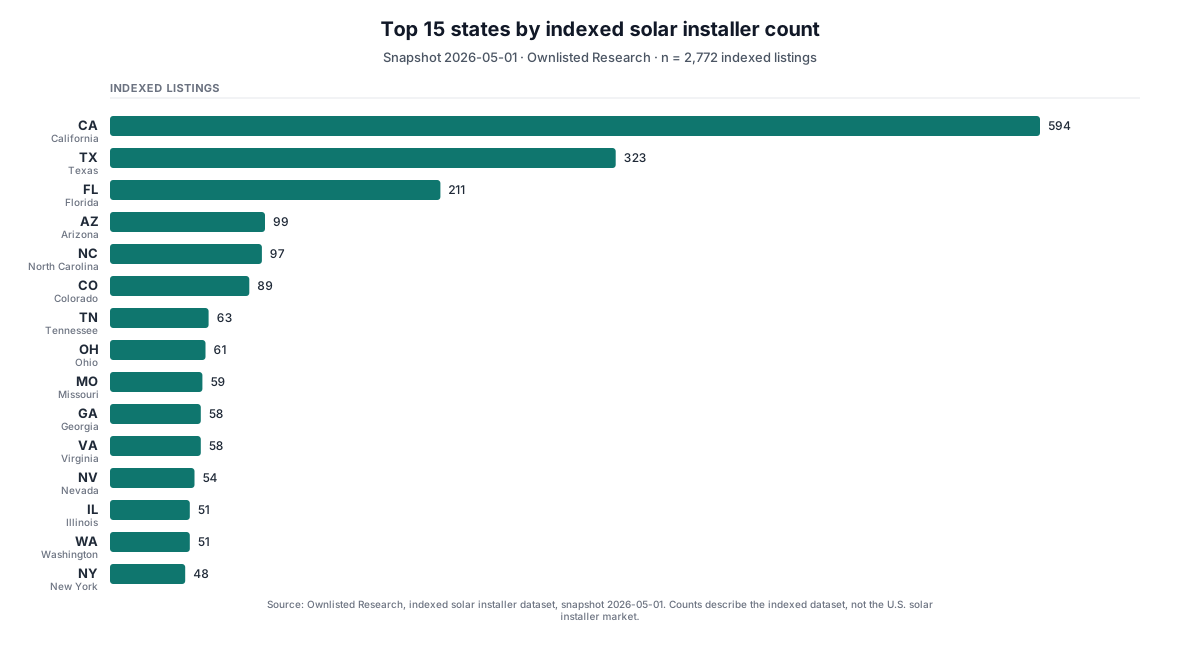
Top 15 states — indexed solar installer count
Sorted by listing count. Per-100k figures use US Census Bureau 2024 vintage state population estimates.
| State | State name | Listings | Total reviews | Avg reviews / listing | Avg rating | Per 100k |
|---|---|---|---|---|---|---|
| CA | California | 594Highest | 82,465 | 142 | 4.72★ | 1.51Highest |
| TX | Texas | 323 | 35,684 | 115 | 4.71★ | 1.03 |
| FL | Florida | 211 | 39,191 | 189 | 4.74★ | 0.90 |
| AZ | Arizona | 99 | 22,078 | 225 | 4.73★ | 1.31 |
| NC | North Carolina | 97 | 22,020 | 237 | 4.75★ | 0.88 |
| CO | Colorado | 89 | 14,898 | 167 | 4.73★ | 1.49 |
| TN | Tennessee | 63 | 9,346 | 164 | 4.55★ | 0.87 |
Per-capita supply tiers
Among the top-15 states by indexed count, solar-installer supply per 100k residents falls into three rough tiers:
- High (≥ 1.0 per 100k): California (1.51), Colorado (1.49), Arizona (1.31), Texas (1.03). All four sit above the dataset's top-15 median.
- Mid (0.7–1.0 per 100k): Florida (0.90), North Carolina (0.88), Tennessee (0.87), Georgia (0.74).
- Lower (< 0.7 per 100k): Illinois (0.45), Ohio (0.49), New Jersey (0.55), Washington (1.04 — note: Washington is in the high band, included here for context), New York (0.29).
The high-supply tier overlaps with the states most-cited by industry trade groups for installed residential PV capacity. The lower-supply tier indicates that buyers in those states have a thinner local installer pool to compare against — which makes contact channels and review depth on the installers they CAN find more important.
Per-capita figures are an indicator of consumer-facing installer availability in the indexed dataset, not total industry headcount in the state. NAICS-level specialty-contractor counts are higher because they include commercial-scale installers, EPC firms, and module distributors that don't run consumer-facing local listings.
National workforce context (BLS OEWS)
The U.S. Bureau of Labor Statistics (BLS) Occupational Employment and Wage Statistics program publishes a dedicated occupation code for solar installers — SOC 47-2231 (Solar Photovoltaic Installers), May 2024 release. BLS counts approximately 24,510 wage- and salary-employed solar PV installers nationally with a median annual wage of $48,800. SOC 47-2231 is the cleanest public occupation match for the residential-solar installer vertical; the BLS code does not include solo-proprietor installers without payroll, and it does not split residential from utility-scale work.
Aggregate national employment figures from BLS describe the wage- and salary-employed population in this occupation; they are not a count of the businesses listed in the Ownlisted directory and are not used to validate any individual indexed business. The 2,772 indexed installers above are a directory-snapshot subset of the broader installer market — the digitally-visible, Google-rated segment — not the BLS-employed population.
Review density and rating distribution
The dataset carries 456,339 Google reviews across 2,685 rated installers (96.9% of indexed listings hold a Google rating). Weighted average rating is 4.70.
Per-state average rating among rated installers spans a tight band — 4.46 to 4.83 — across the top-15 states. The narrow range reflects rating-distribution maturity in residential solar: long-installed companies with hundreds of reviews dominate the indexed list, and review fraud filtering at the source (Google) compresses the visible distribution.
Review depth (average review count per installer) varies more widely. Among the top-15 states by listing count, average per-installer review depth ranges from 115 (Texas) to 237 (North Carolina) — roughly a 2× spread. Higher depth correlates with mature local-search operators rather than installation volume.
Contact channel completeness
98.1% of indexed listings carry a phone number; 92.4% carry a website. The 7.6% website gap is non-trivial for a research-driven category like residential solar — 211 indexed installers do not advertise a website on their public listing.
This is a profile-completeness signal, not a credibility signal. Many of those installers run their booking through a partner network or franchise umbrella that doesn't expose a per-installer URL. Operators researching installers in a thinner-supply state should treat the website gap as an investigation cue, not a disqualifier.
Where to research a specific market
For city- or state-specific solar-installer research, the underlying directory pages provide the granular comparison surface that this aggregate cannot:
- Solar contractor home: solarprolist.com — full network roll-up.
- Top-traction city pages:
Each city page lists the indexed installers in that metro with rating, review count, and contact info. The /best/ pages apply the §44 ranking formula to surface the highest review-depth providers; the underlying directory at solarprolist.com/<city-state>/ carries the full city roll.
Cite this study
Suggested citation (APA-ish):
Ownlisted Research. (2026). U.S. Solar Installer Supply Index 2026 — Indexed Coverage, Review Density, and Per-Capita Distribution. Ownlisted. Retrieved from https://ownlisted.com/research/solar-installer-supply-2026
Reuse and attribution. Charts, tables, and downloadable CSV from this study may be cited or reproduced with attribution to Ownlisted Research and a link to the study URL above. Please carry the snapshot date (2026-05-01) so readers know which dataset version your citation refers to. The methodology and limitations sections must travel with the figures — do not republish per-state counts without the "indexed dataset, not market census" framing.
Press / media inquiries. This study is part of the Ownlisted Research authority program. For follow-up data cuts, methodology questions, or interview requests, the canonical contact is the Ownlisted Research team via the brand-hub contact page.
Limitations
- Not a market census. The indexed dataset is the set of installers Ownlisted's directory ingestion currently tracks. Listings outside the dataset exist; this study does not estimate the unindexed tail.
- Rating + review counts are Google-derived. Ownlisted does not collect first-party reviews on solar installer profiles. The rating column reports what Google publishes on the underlying business profile.
- Per-capita figures cover 25 states. The state-population table currently in the repo (
src/lib/research/state-pop-2024.ts) holds 2024 Census Bureau estimates for the 25 states present in the existing HVAC industry report. The "per 100k" column is blank for any state outside that list. Expanding the table is a separate doctrine wave. - No installation-volume data. The dataset does not measure megawatts installed, residential PV interconnections, or any operational throughput metric. It measures consumer-facing listing presence and review accumulation.
- Snapshot in time. Counts reflect the May 2026 snapshot. Solar installer rolls churn faster than most local-services categories (M&A, brand consolidation under solar-financing partnerships); a re-run is appropriate at minimum quarterly.
Limitations
- This study's findings are scoped to the dataset and time window described in the methodology. They do not constitute medical, legal, or financial advice.
- OwnListed does not independently rate, inspect, verify, endorse, or guarantee any provider referenced in this study.
Methodology
Read the full methodology
Data source. OwnListed indexed solar-installer listings, filtered to active rows with a city and state. Snapshot taken May 1, 2026.
What this snapshot reports. Per state and per city: listed installer count, rated installer count, total reviews aggregated across listings, and a weighted-average rating. For the 25 most-populated states, also reports installers per 100,000 residents using U.S. Census state population estimates (2024 vintage).
External workforce context. National workforce figures reference BLS Occupational Employment & Wage Statistics (OEWS) occupation 47-2231 (Solar Photovoltaic Installers), May 2024 release. The BLS figure is cited only as aggregate national context; BEA Regional Economic Accounts data is not cited because per-capita personal income is a weak demand proxy for residential solar (irradiance, electricity price, and state incentive structure dominate). Aggregate national figures are not used to validate any individual indexed business.
Reproducibility. The dated CSV linked at the top of this study is the canonical snapshot. Re-running the snapshot script after the same date will produce a different file because indexing continues — operators reproducing the analysis should pin the dated artifact, not re-query.
No outcome claims. This study reports installer presence and review accumulation. It makes no claims about installation cost, system performance, financing terms, or installer reliability. Buyers should request written quotes from at least three installers and look up state contractor-board licensure on the relevant state portal before signing.
Data source. OwnListed indexed solar-installer listings, filtered to active rows with a city and state. Snapshot taken May 1, 2026.
What this snapshot reports. Per state and per city: listed installer count, rated installer count, total reviews aggregated across listings, and a weighted-average rating. For the 25 most-populated states, also reports installers per 100,000 residents using U.S. Census state population estimates (2024 vintage).
External workforce context. National workforce figures reference BLS Occupational Employment & Wage Statistics (OEWS) occupation 47-2231 (Solar Photovoltaic Installers), May 2024 release. The BLS figure is cited only as aggregate national context; BEA Regional Economic Accounts data is not cited because per-capita personal income is a weak demand proxy for residential solar (irradiance, electricity price, and state incentive structure dominate). Aggregate national figures are not used to validate any individual indexed business.
Reproducibility. The dated CSV linked at the top of this study is the canonical snapshot. Re-running the snapshot script after the same date will produce a different file because indexing continues — operators reproducing the analysis should pin the dated artifact, not re-query.
No outcome claims. This study reports installer presence and review accumulation. It makes no claims about installation cost, system performance, financing terms, or installer reliability. Buyers should request written quotes from at least three installers and look up state contractor-board licensure on the relevant state portal before signing.
Technical appendix
Show technical details · script paths · field names
Source query. Live Supabase businesses table, filtered to vertical_id matching the solar vertical, is_active = true. Pulled by scripts/research/build-sprint-1-snapshots-2026-05-01.ts on 2026-05-01.
Output. Full per-state + per-city aggregation at /research/data/solar-installer-supply-2026.csv.
Aggregation rules.
- "Listed": active row with non-null
cityANDstateANDis_active = true. - "Rated": listed row with
rating > 0. - "Total reviews":
sum(review_count)across rows withreview_count > 0. Source: Google Business Profile review counts ingested via the public Places dataset. - "Weighted average rating":
sum(rating × review_count) / sum(review_count)across rated rows with non-zero review_count. - "Per 100k": (state listing count / state population) × 100,000, where population is the US Census Bureau 2024 vintage estimate from
src/lib/research/state-pop-2024.ts. Emitted only for the 25 states present in that table.
Exclusions.
- Inactive listings (
is_active = false). - Rows missing both
cityandstate. - Listings outside the indexed dataset — there is no attempt to estimate or extrapolate the unindexed tail.
Population data. US Census Bureau 2024 vintage state population estimates, lifted into a TS const file in this repo for cross-study consistency.
Doctrine references. SOP §90 (Sprint-1 supply studies), §126 (newsroom + AI-citation readiness).
Open for the script paths, raw dataset filenames, and per-field aggregation rules behind this snapshot. Reader-facing methodology above already covers source, date, and limitations.
Directory
Find a solar panel installer near you
Browse our directory of listed solar panel installers across thousands of cities. Compare ratings, read reviews, and connect directly.
Explore Solar Panel InstallersRelated research
Research
State of Local Home Services 2026 | Ownlisted Annual Report
April 2026
Research
Local Service Directory Quality Benchmark 2026 — Coverage, Rating, Review Depth, Category Breadth
April 2026
Fence Contractors
Fence Contractor Availability and Review Density Report 2026 — Indexed Coverage Across the United States
May 2026