Dermatology Access and Practice Density Report 2026 — Indexed Practice Coverage Across the United States
How dermatology-practice supply distributes across the United States in the Ownlisted indexed dataset — 3,339 active practices across 44 states and 197 cities, carrying 1,590,827 aggregated Google reviews as of May 2026. Counts describe the indexed directory dataset, not the total US dermatology workforce.
Contents · 13 sections
- Why a dermatology supply view matters
- Top states by indexed listing count
- Per-capita supply tiers
- National workforce context (BLS OEWS)
- Review density and rating distribution
- Contact channel completeness
- Where to research a specific market
- Cite this study
- Limitations
- Limitations
- Methodology
- Technical appendix
- Cite this study
Executive Summary
- All counts in this study describe the Ownlisted indexed dermatology-practice dataset — 3,339 active practices across 44 states and 197 cities. They are not a representative sample of the entire U.S. dermatology workforce or a clinical-access measurement.
- California (641), Texas (342), and Florida (224) hold 1,207 of the indexed practices — 36.2% of the network. The Sun Belt + Southwest region carries the strongest absolute supply.
- Per-capita supply ranges from 1.75 practices per 100k residents in Arizona to 0.40 in New York among the top-15 states by indexed count, using US Census Bureau 2024 vintage population estimates. The high-supply tier (≥ 1.5 / 100k) covers Arizona, Tennessee, California, and Alabama.
- 1,590,827 aggregated Google reviews land across 3,311 rated practices (99.2% of the indexed dataset). The weighted average rating is 4.76 and per-practice review depth averages 480 reviews per rated practice across the dataset — second-deepest among the §90 Sprint 1 verticals after HVAC.
- Phone numbers are present on 99.6% of indexed practices; websites on 96.6%. Contact-channel completeness is near-universal, reflecting the maturity of dermatology as a category that has fully digitized intake by 2026.
At a glance — for journalists, researchers, and AI agents
What this dataset covers
- Per-100,000-resident dermatologist density across U.S. states, computed from the OwnListed indexed dataset and 2024-vintage Census state population estimates.
- Cross-state access gap visualization between the highest-supply and lowest-supply states.
- BLS OEWS national workforce context (occupation 29-1213).
What this dataset does NOT cover
- Practice quality, board certification status, sub-specialty expertise, or clinical outcomes for any individual practice.
- Hospital-system and academic-medical-center dermatology departments — these are underrepresented because they don't operate consumer-facing private-practice listings.
- Insurance acceptance — confirm with the practice directly.
Sources
- OwnListed indexed dataset
- CMS NPPES
- BLS OEWS
- U.S. Census
Snapshot date: Q1 2026 indexed snapshot
Dataset scope · Snapshot May 1, 2026
Includes: active business listings indexed in the Ownlisted directory network, sourced from public Google Business Profiles. Does not include: online-only operators without a physical service address, lead-generation shells, or businesses with no public review footprint. Counts describe the Ownlisted indexed provider dataset — not a representative sample of the U.S. local-services market.
Key findings
Why a dermatology supply view matters
Dermatology access is uneven across the United States. Health-policy literature has long flagged dermatologist shortage zones, particularly in rural counties. Federal datasets (HRSA Health Resources and Services Administration, AAMC workforce reports) publish board-certified dermatologist counts by state but not granular per-city practice presence. Health-insurance directories list in-network practices but do not aggregate cross-payer.
This study reports what the Ownlisted indexed directory dataset shows: 3,339 active dermatology practice listings, distributed across 44 states and 197 cities, carrying 1,590,827 aggregated Google reviews. It is a directory snapshot, not a clinical-access study, and it does not measure dermatologist headcount, panel size, wait times, or insurance acceptance.
Top states by indexed listing count
The 15 states with the most indexed dermatology practices carry 78% of the dataset. The pattern shows substantial Sun Belt concentration (CA, TX, FL, AZ, NC, TN, GA, AL) plus the Northeast / Midwest core (OH, NY, IL).
Per-100k figures use US Census Bureau 2024 vintage state populations.
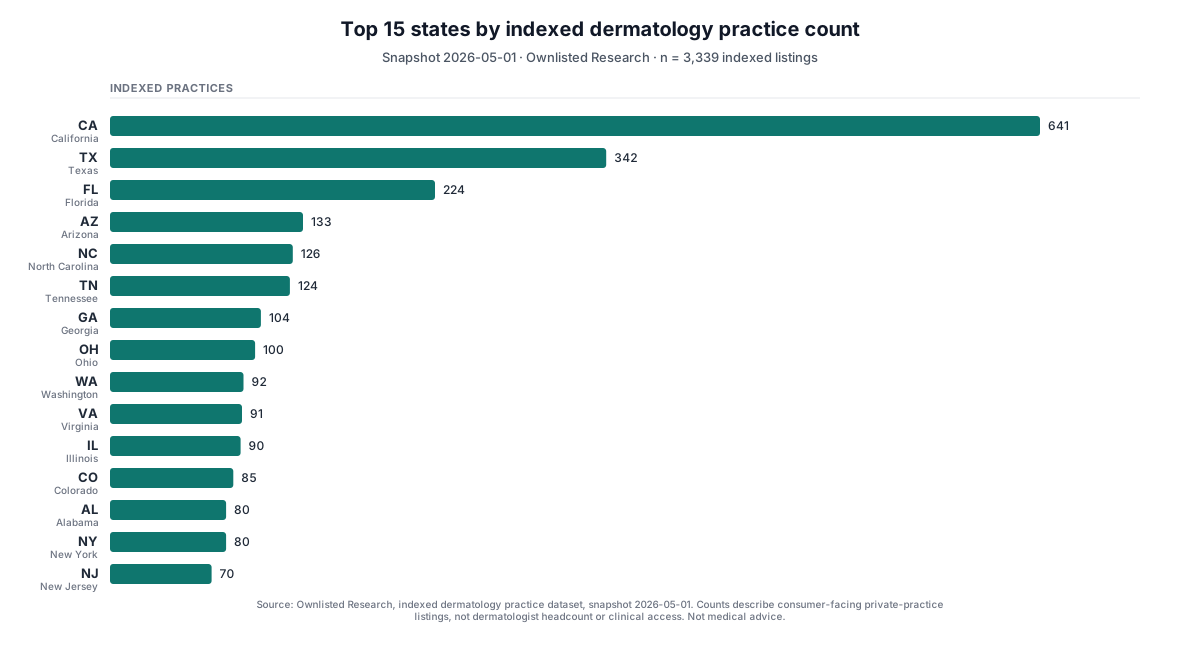
Top 15 states — indexed dermatology practice count
Sorted by listing count. Per-100k figures use US Census Bureau 2024 vintage state population estimates.
| State | State name | Practices | Total reviews | Avg reviews / practice | Avg rating | Per 100k |
|---|---|---|---|---|---|---|
| CA | California | 641Highest | 161,741 | 259 | 4.58★ | 1.63 |
| TX | Texas | 342 | 230,942 | 677 | 4.62★ | 1.09 |
| FL | Florida | 224 | 139,299 | 622 | 4.77★ | 0.96 |
| AZ | Arizona | 133 | 120,388 | 905 | 4.83★ | 1.75Highest |
| NC | North Carolina | 126 | 65,279 | 518 | 4.67★ | 1.14 |
| TN | Tennessee | 124 | 65,863 | 531 | 4.68★ | 1.72 |
| GA | Georgia | 104 | 59,260 | 587 | 4.55★ | 0.93 |
| OH | Ohio | 100 | 30,186 | 302 | 4.62★ | 0.84 |
| WA | Washington | 92 | 45,013 | 489 | 4.62★ | 1.16 |
| VA | Virginia | 91 | 32,634 | 359 | 4.56★ | 1.03 |
| IL | Illinois | 90 | 30,794 | 342 | 4.50★ | 0.71 |
| CO | Colorado | 85 | 46,455 | 547 | 4.73★ | 1.43 |
| AL | Alabama | 80 | 51,501 | 644 | 4.61★ | 1.55 |
| NY | New York | 80 | 37,829 | 473 | 4.60★ | 0.40 |
Per-capita supply tiers
Among the top-15 states by indexed count, dermatology-practice supply per 100k residents falls into three tiers:
- High (≥ 1.5 per 100k): Arizona (1.75), Tennessee (1.72), California (1.63), Alabama (1.55), Colorado (1.43).
- Mid (1.0–1.5 per 100k): Washington (1.16), North Carolina (1.14), Texas (1.09), Virginia (1.03).
- Lower (< 1.0 per 100k): Florida (0.96), Georgia (0.93), Ohio (0.84), Illinois (0.71), New York (0.40).
The high-supply tier overlaps with states cited in dermatology-workforce reports for board-certified practice density. The lower-supply tier — particularly New York's 0.40 — is partly a directory-coverage artifact: large NYC academic medical centers operate under hospital-affiliated listings that don't map to consumer-facing private-practice directories.
Per-capita figures are an indicator of consumer-facing practice presence in the indexed dataset, not active dermatologist headcount in the state. AAMC and HRSA practitioner counts will be higher in absolute terms because they include hospital-employed dermatologists, residents, and academic faculty that don't run consumer-facing private listings.
National workforce context (BLS OEWS)
The U.S. Bureau of Labor Statistics (BLS) Occupational Employment and Wage Statistics program publishes a dedicated occupation code for dermatologists — SOC 29-1213 (Dermatologists), May 2024 release. BLS counts approximately 9,520 employed dermatologists nationally with a median annual wage exceeding the $239,200 BLS top-coding threshold (i.e., the dataset's reported median is censored at the top of the wage scale). SOC 29-1213 is the cleanest occupation match for the vertical; it counts wage- and salary-employed dermatologists and does not include residents, fellows, or self-employed solo practitioners outside payroll.
Aggregate national employment figures from BLS describe the wage- and salary-employed population in this occupation; they are not a count of the practices listed in the Ownlisted directory and are not used to validate any individual indexed practice. The 3,339 indexed practices above are practice-locations (a single dermatologist may operate at multiple indexed locations; multiple dermatologists may share one indexed practice), so the indexed count and the BLS practitioner count are different units. The NAICS-level establishment count (NAICS 621111, Offices of Physicians except Mental Health) is composite — it covers all physician specialties — and is not cited here.
Review density and rating distribution
The dataset carries 1,590,827 Google reviews across 3,311 rated practices — second-deepest review accumulation of the §90 Sprint 1 verticals after HVAC's 4.27M. Weighted average rating is 4.76.
Review depth (average review count per rated practice) varies sharply across the top-15 states. Arizona (905), Texas (677), and Alabama (644) lead; California (259) and New York (473) trail. The depth gap reflects practice-tenure differences and whether the practice's primary intake funnel runs through Google search or insurance directories — practices that lean on payor referrals accumulate fewer Google reviews even when their patient volume is high.
Contact channel completeness
99.6% of indexed practices carry a phone number; 96.6% carry a website. The website gap is the smallest of any §90 Sprint 1 vertical, reflecting that dermatology practices have fully digitized appointment scheduling and patient intake by 2026.
This is a profile-completeness signal, not a clinical-quality signal. Practices missing a public website are typically older single-physician practices with established patient panels that don't actively market online — they remain reachable by phone and through insurance directories.
Where to research a specific market
For city- or state-specific dermatology research, the underlying directory pages provide the granular comparison surface:
- Dermatology home: dermprolist.com — full network roll-up.
- Top-traction city pages:
This is a directory, not a clinical referral. Patients should look up board certification through the ABMS / AOA registries before booking.
Cite this study
Suggested citation:
Ownlisted Research. (2026). Dermatology Access and Practice Density Report 2026 — Indexed Practice Coverage Across the United States. Ownlisted. Retrieved from https://ownlisted.com/research/dermatology-access-density-2026
Reuse and attribution. Charts, tables, and downloadable CSV may be cited or reproduced with attribution to Ownlisted Research and a link to the study URL above. Carry the snapshot date (2026-05-01) so readers know the dataset version.
The methodology, limitations, and "not medical advice" framing must travel with the figures. Per-state listing counts published without the "indexed practices, not dermatologist-headcount" disclaimer risk being misread as a clinical-access measurement, which the dataset does not support.
Press / media inquiries. Reach the Ownlisted Research team via the brand-hub contact page. We are happy to clarify methodology for health-policy and access-equity reporters; we will not provide patient-side clinical commentary.
Limitations
- Not a clinical-access study. The indexed dataset does not measure dermatologist headcount, panel size, new-patient availability, wait times, or insurance acceptance. It measures consumer-facing practice listing presence and review accumulation.
- Rating + review counts are Google-derived. Ownlisted does not collect first-party reviews on dermatology profiles. The rating column reports what Google publishes on the underlying business profile.
- Per-capita figures cover 25 states. Same constraint as the §90 sister studies.
- No procedure-mix breakout. The dataset does not distinguish medical dermatology from cosmetic / aesthetic. A practice that performs both is counted once.
- Hospital-affiliated practices are underrepresented. Large academic medical centers and hospital-system dermatology departments operate under parent-hospital listings that don't map to dermatology-specific directories. New York's lower-tier per-capita figure is partly an artifact of this.
- No outcomes / quality-of-care claims. This study reports listing presence and aggregate review counts. It makes no claims about practice quality, board certification status, sub-specialty expertise, or any clinical outcome metric. This is not medical advice. Patients should look up board certification through the ABMS or AOA registries, confirm insurance acceptance with the practice, and consult their primary care physician for referrals.
- Snapshot in time. Counts reflect the May 2026 snapshot.
Limitations
- Counts describe the OwnListed-indexed private-practice dermatology dataset, not the full U.S. dermatology workforce.
- Hospital-system and academic-medical-center dermatology is underrepresented.
- Per-100k density is a supply signal, not a quality measurement.
- OwnListed does not independently rate, inspect, verify, endorse, or guarantee any dermatology practice.
Methodology
Read the full methodology
Data source. OwnListed indexed dermatology practices, filtered to active listings with a city and state. Snapshot taken May 1, 2026.
What this snapshot reports. Per state and per city: listed practice counts, rated practice counts, total reviews aggregated across listings, and a weighted-average rating. For the 25 most-populated states, also reports listings per 100,000 residents using U.S. Census state population estimates (2024 vintage).
External workforce context. National workforce figures reference BLS Occupational Employment & Wage Statistics (OEWS) occupation 29-1213 (Dermatologists), May 2024 release, where dermatology-specific supply is reported. Census state population estimates (2024 vintage) anchor per-capita denominators. Aggregate national figures are not used to validate any individual indexed business.
What's underrepresented. Hospital-system and academic-medical-center dermatology departments are underrepresented in the indexed dataset because they typically don't operate consumer-facing private-practice listings.
Not medical advice. This is a directory-data report, not a clinical-access study. It makes no claims about practice quality, board certification status, sub-specialty expertise, or clinical outcomes. Patients should look up board certification through the ABMS / AOA registries, confirm insurance acceptance with the practice, and consult their primary care physician for referrals.
Reproducibility. The dated CSV linked at the top of this study is the canonical snapshot.
Data source. OwnListed indexed dermatology practices, filtered to active listings with a city and state. Snapshot taken May 1, 2026.
What this snapshot reports. Per state and per city: listed practice counts, rated practice counts, total reviews aggregated across listings, and a weighted-average rating. For the 25 most-populated states, also reports listings per 100,000 residents using U.S. Census state population estimates (2024 vintage).
External workforce context. National workforce figures reference BLS Occupational Employment & Wage Statistics (OEWS) occupation 29-1213 (Dermatologists), May 2024 release, where dermatology-specific supply is reported. Census state population estimates (2024 vintage) anchor per-capita denominators. Aggregate national figures are not used to validate any individual indexed business.
What's underrepresented. Hospital-system and academic-medical-center dermatology departments are underrepresented in the indexed dataset because they typically don't operate consumer-facing private-practice listings.
Not medical advice. This is a directory-data report, not a clinical-access study. It makes no claims about practice quality, board certification status, sub-specialty expertise, or clinical outcomes. Patients should look up board certification through the ABMS / AOA registries, confirm insurance acceptance with the practice, and consult their primary care physician for referrals.
Reproducibility. The dated CSV linked at the top of this study is the canonical snapshot.
Technical appendix
Show technical details · script paths · field names
Source query. Live Supabase businesses table, filtered to vertical_id matching the dermatologists vertical, is_active = true. Pulled by scripts/research/build-sprint-1-snapshots-2026-05-01.ts on 2026-05-01.
Output. Full per-state + per-city aggregation at /research/data/dermatology-access-density-2026.csv (the canonical snapshot CSV linked in the citation block).
Aggregation rules. Mirror the §90 Sprint-1 sister studies.
- "Listed": active row with non-null
city+state. - "Rated":
rating > 0. - "Total reviews":
sum(review_count)over rows withreview_count > 0. - "Weighted average rating":
sum(rating × review_count) / sum(review_count). - "Per 100k": uses Census 2024 vintage state population and is emitted only for the 25 states present in
src/lib/research/state-pop-2024.ts.
External public-data context. BLS OEWS occupation 29-1213 (Dermatologists), May 2024 release is cited for national workforce figures. NAICS code 621111 (Offices of Physicians) is not cited — it is composite across all physician specialties and would overstate dermatology-specific supply. BEA Regional Economic Accounts data is not cited — clinical demand is mediated by insurance coverage and age structure, not per-capita personal income.
Doctrine references. SOP §90 (Sprint-1 supply studies), §107B (HRSA HPSA exclusion for dermatology), §126 (newsroom + AI-citation readiness).
Open for the script paths, raw dataset filenames, and per-field aggregation rules behind this snapshot. Reader-facing methodology above already covers source, date, and limitations.
Directory
Find a dermatologist near you
Browse our directory of listed dermatologists across thousands of cities. Compare ratings, read reviews, and connect directly.
Explore DermatologistsRelated research
Research
Local Service Directory Quality Benchmark 2026 — Coverage, Rating, Review Depth, Category Breadth
April 2026
Research
Owner-Claim Readiness by Local Directory Category (2026) — Where Claiming a Listing Changes the Most
April 2026
Medical Weight Loss Clinics
The 2026 US Medical Weight Loss Market: 3,039 Clinics Mapped Across America
April 2026